We live in a world riddled with grave issues: wars, climate change, religious polarization, and the lingering effects of the pandemic. Living in this chaotic world can influence a creative person in different ways. Sometimes, all the suffering around us blocks our creativity and makes us ask the question: why do we even bother to create in a world that is about to fall apart? For another set of artists, the suffering is a trigger that prompts them to create overtly dramatic works that paint a black-and-white picture of the world that often misses the nuances of real life.
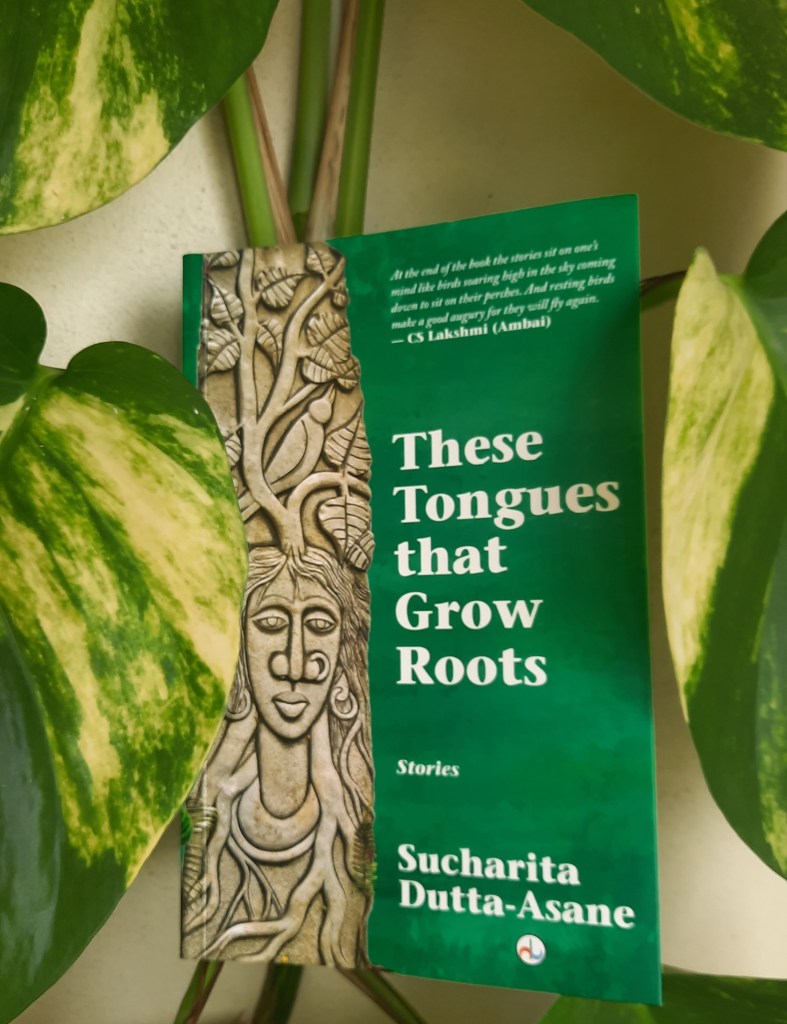
Then, there is a third kind of artists who understand that despite all these conflicts and tragedies, life flourishes and flows, and they observe and capture its ebbs and flows in their works. Sucharita Dutta-Asane’s short story collection, ‘These Tongues that Grow Roots,’ published by Dhauli Books, comes in this third category. Sucharita’s stories show a deep understanding and empathy towards the world in which we live. Her stories portray characters whose lives are influenced, altered, destroyed, or reformed by the conflicts and issues of the modern world.
There are fifteen stories in the collection, and each tale portrays characters who are affected by a universal crisis or a conflict. Sometimes, they are the direct victims of the crisis, like Martin D’Mello, the protagonist of the story Interlude. The pandemic cuts off the 72-year-old Martin from the world outside. His attempts to regain normalcy fail miserably, and Martin starts pondering difficult questions about life and death. Some of the stories portray characters who are the indirect victims of violence and polarization, like Daisy, the circus clown in the story (Un)harnessed, who loses her mother and father figure to a religiously polarized world. However, Martin and Daisy are trying to cope with their situations, to hold onto hope, and to offer hope to people who need it the most.
The stories also show us how the man-made crises have made life difficult and dismal for the younger generation. The young protagonist of the story, Zeitgeist, lives in a hopeless world of climate change and destructive urbanization. They have inherited an ugly world that’s almost impossible to restore. Yet, they sees the beautiful images of an erstwhile green world and hopes their city can still salvage itself from the concrete jungles and pollution. This is one striking aspect of Sucharita’s stories: while they deal with distressing themes, they also show us that people still possess the potential to heal themselves and the world.
Even though we all live in the same world and experience the same crises, it affects different people in different ways. We are often too involved in our lives and miss seeing the perspectives of other people. The stories in this collection tell us stories of people who are affected by the same conflicts and issues that we are, yet their experiences are very different from ours. This opens our eyes to a diverse range of human experiences and gives us new perspectives about life. For example, the entire world suffered during the pandemic. However, each of us experienced it differently. The story Pinki portrays a young man torn between love and his fear of the virus and his life swings between these two ends like a pendulum.
Each story in this collection is a deep exploration of human emotions. The readers experience the helplessness of an old man in the story Interlude, a sense of abandonment and loneliness, Only the Synonyms of Emptiness. The stories also explore complex relationships between parents and children, between cousins, and between friends. Stories in the collection ‘These Tongues that Grow Roots’ take place in the real world, a world that we know too well and a world that we think we inhabit. Yet, each of these stories allows the reader to experience the same world in different ways. While we read these stories, we momentarily slip into the world of these characters and look at their issues and conflicts through a new set of eyes.
 Salini Vineeth
Leave a comment